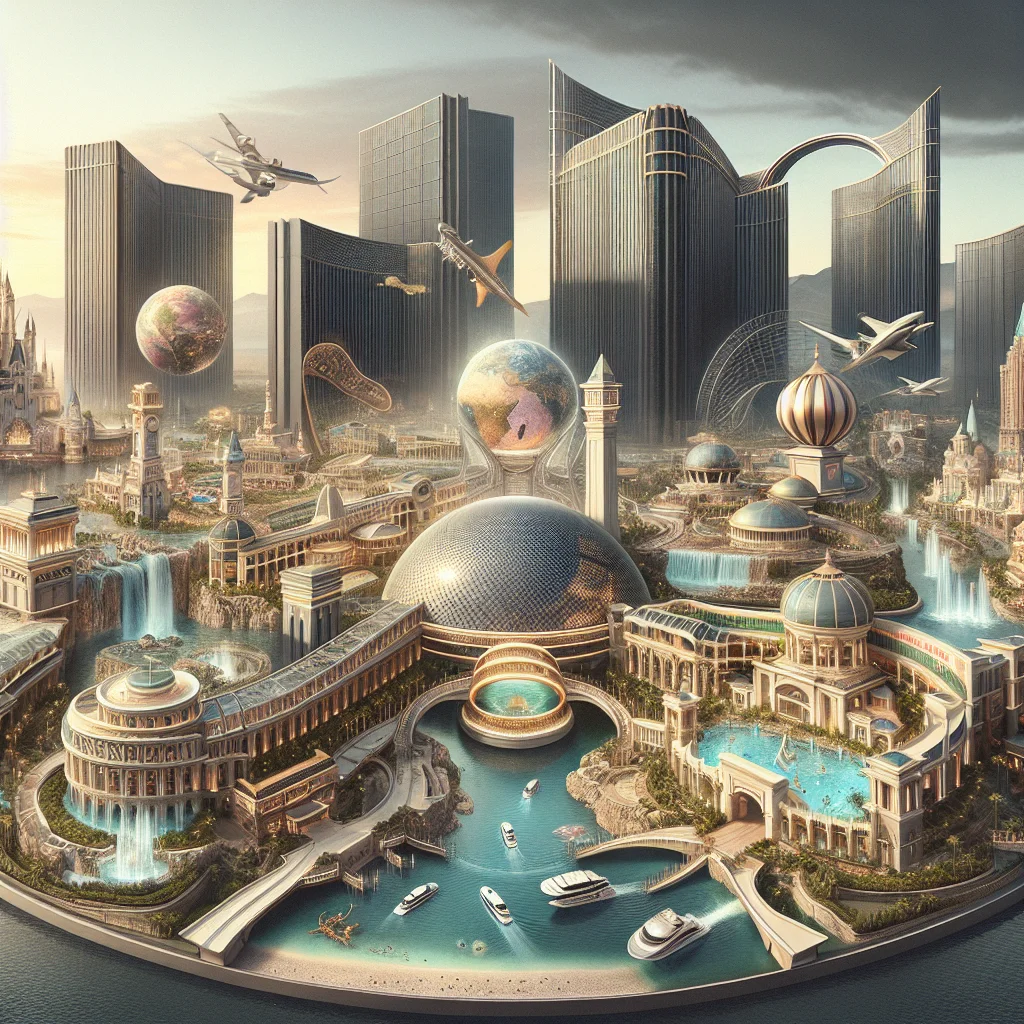
The concept of the themed casino resort has been perfected and popularized by a handful of iconic properties that have transcended their primary function to become global landmarks. These are the pioneers and the pinnacles, the resorts that didn’t just adopt a theme but executed it on such a grand scale that they became synonymous with the idea itself. They have drawn millions of visitors, inspired countless imitators, and permanently altered the skylines and economies of their host cities. From the neon-drenched boulevards of Las Vegas to the Cotai Strip in Macau and the pristine shores of the Bahamas, these legendary destinations offer a masterclass in ambition. Each tells a unique story of cultural interpretation, architectural daring, and relentless pursuit of spectacle, serving as living museums of entertainment design and proving that with enough vision and capital, any fantasy can be made concrete, luxurious, and open for business twenty-four hours a day.
The Las Vegas Pioneers: Where Fantasy Took Root
Las Vegas is the undisputed birthplace and evolutionary hub of the mega-themed resort. The transformation began in earnest with the opening of The Mirage in 1989, which introduced the city to the concept of a fully immersive, destination casino. Its volcano, erupting nightly on the Strip, was a revolutionary statement. But it was the trio that followed that truly cemented the model: Excalibur (1990), with its cartoonish medieval castle turrets; Luxor Las Vegas (1993), a colossal black glass pyramid complete with a giant beam of light shooting into space; and New York-New York (1997), a condensed, roller-coaster-wrapped skyline of the Big Apple. These properties were not subtle; they were bold, literal, and spectacular. They proved that a powerful, easily recognizable theme could attract a mass market, offering a complete vacation package of gaming, affordable rooms, themed dining, and family-friendly entertainment under one fantastical roof, setting the template for everything that followed.
Luxor Las Vegas & The Venetian: Engineering the Impossible
Two Las Vegas properties stand out for their sheer audacity of theme and engineering. Luxor Las Vegas remains one of the most architecturally distinctive buildings on Earth. The 30-story pyramid houses a vast atrium where angled elevator rides are an attraction in themselves. Its theme of ancient Egypt is woven into every detail, from sphinx statues to Nile River-themed attractions. It demonstrated that a theme could be both educationally intriguing and wildly entertaining. Its counterpart in opulence is The Venetian Resort (1999). This resort didn’t just suggest Venice; it recreated it indoors. Its most famous feature is the Grand Canal Shoppes, where authentic singing gondoliers pilot boats along a crystal-clear canal under a painted blue sky ceiling that mimics dawn-to-dusk lighting. With replicas of Venetian landmarks like the Rialto Bridge and St. Mark’s Campanile, The Venetian achieved a level of detail and romantic immersion that raised the bar for all future luxury theming, proving that guests were willing to pay a premium for transportive elegance and scale.
Atlantis Paradise Island: The Ultimate Aquatic Adventure
While Vegas mastered the desert fantasy, Atlantis Paradise Island in The Bahamas claimed the throne of the aquatic-themed resort. More than just a casino hotel, Atlantis is a 141-acre water-world themed around the myth of the lost continent. Its centerpiece is the breathtaking open-air marine habitat, home to over 50,000 aquatic animals. Guests can slide through a transparent tube in the Predator Lagoon, surrounded by sharks, or relax in a pool nestled within the ruins of faux-Atlantean temples. The resort’s architecture, with its iconic pink towers and royal-blue roofs, evokes a sense of ancient, sunken majesty rediscovered. Atlantis successfully expanded the themed resort model into a comprehensive family destination where the casino is just one component of a vast array of attractions, including a world-class water park, dolphin encounters, and marine biology exhibits. It showed that a theme could be educational, thrilling, and luxurious, appealing equally to high-rollers and multi-generational families.
The Venetian Macao and City of Dreams: The Asian Evolution
As the themed resort model migrated to Asia, it was adapted and amplified to suit regional tastes and scales. The Venetian Macao (2007) took its Las Vegas sibling’s concept and supersized it, becoming the largest casino in the world and the largest single-structure hotel building in Asia. It doubled down on the Italianate fantasy, creating an even more expansive canal system and shopping plaza. Its success proved the global appeal of the immersive theme. Meanwhile, City of Dreams (2009) in Macau presented a more modern, cinematic approach to theming. Instead of a single historical theme, it offers a rotating series of spectacular shows and experiences, like the world-famous “House of Dancing Water” aqua-theater show. Its architecture is sleek and dynamic, with a facade that becomes a massive digital canvas for light shows. These Macau properties represent the evolution of the theme from a static architectural style to a dynamic, experience-driven spectacle, catering to the preferences of the Asian luxury market for grand, shared experiences and high-stakes gaming in a cutting-edge environment.
Marina Bay Sands: The Modern Icon
Departing from historical fantasy, Marina Bay Sands in Singapore (2010) defined a new archetype: the themed resort as a symbol of futuristic urban ambition. Its theme is modern architectural marvel itself. The iconic design, featuring three soaring hotel towers crowned by the gravity-defying SkyPark, created an instantly recognizable global silhouette. The resort’s theme is one of ultra-modern luxury, sustainability, and artistic expression. It houses a world-class museum, a massive lotus-shaped science museum, and luxury retail pavilions. The infinity pool on the SkyPark, seemingly spilling into the city skyline, became one of the most photographed pools in the world. Marina Bay Sands demonstrated that a theme could be forward-looking and abstract, rooted in engineering wonder and artistic vision rather than narrative history. It appealed to a cosmopolitan, design-conscious clientele and played a pivotal role in rebranding Singapore as a premium, integrated resort destination, showing that theming could be sophisticated, avant-garde, and culturally significant.
Legacy and Influence: Shaping Global Tourism
The impact of these iconic resorts extends far beyond their gaming revenue. They have fundamentally shaped global tourism, creating “must-see” destinations that draw visitors from every continent. They spurred massive infrastructure development in their regions, from improved airports to new public transportation systems. Culturally, they have influenced architecture, entertainment, and even interior design trends worldwide. Their business model—the integrated resort—has been adopted as official policy in countries like Singapore and Japan, seen as a catalyst for economic growth. These properties also face the ongoing challenge of reinvention; in a competitive market, even the most iconic theme can become dated. This drives continuous investment in renovations, new attractions, and celebrity chef restaurants to maintain relevance. Their enduring legacy is the proof of concept: that a powerful, well-executed theme can create an economic and cultural powerhouse, a place where fantasy is not an escape from reality, but a driver of a very real and prosperous industry, inspiring awe and setting the standard for generations of resorts to come.
The world’s most famous themed casino resorts are more than just places to gamble; they are monuments to a specific era of entertainment ambition, testaments to what happens when unlimited creativity meets formidable engineering and capital. From the playful castles of Las Vegas to the aquatic ruins of the Bahamas and the futuristic curves of Singapore, each iconic property tells a story about the desires of its time and the vision of its creators. They have educated the public on what a vacation can be, offering a guaranteed, spectacular, and controlled experience of the extraordinary. As they continue to evolve and new icons rise, they remind us that the human appetite for narrative and spectacle is boundless. These resorts are the physical embodiment of that appetite, standing as permanent invitations to step out of our everyday lives and into a grander, more thrilling story, if only for a weekend, forever changing our expectations of what hospitality can achieve.